How Rubber Bands Are Made: The Complete 8-Step Manufacturing Process
Key Takeaways
- Natural rubber bands are made from Hevea latex through an 8-step process: compounding, extrusion, water-cooling, vulcanization, and high-speed cutting.
- Vulcanization is the chemical cross-linking of rubber molecules with sulfur under heat, forming the elastic memory network.
- Precision extrusion controls diameter and wall thickness, while high-speed rotary cutting determines the band's final width.
Table of Contents
- Where Does Rubber Band Production Begin?
- Step 1 - Latex Harvesting
- Key facts about latex harvesting:
- Step 2 - Cup Lump Collection
- Step 3 - Compound Preparation
- Step 4 - Extrusion
- Different die sizes are used for different product types:
- Step 5 - Water Cooling
- Step 6 - Vulcanization (Baking)
- The process:
- Step 7 - Precision Cutting
- Step 8 - Weighing and Packaging
- Why Do Rubber Bands Snap Easily (And How to Prevent It)?
- What Makes the Difference Between a Good and a Bad Rubber Band?
- How Maruey Rubber Controls Quality at Every Step
- Frequently Asked Questions
- Interested in Sourcing Rubber Bands from a Quality Manufacturer?
Rubber bands are one of the most widely used products in the world - yet most people have never considered how are natural rubber bands manufactured. Behind every band is a sophisticated process involving agricultural harvesting, precision chemistry, and engineering-grade quality control.
This guide walks through the complete factory process of making industrial rubber bands, from the first cut on a rubber tree in Thailand to the finished, packaged product ready for global shipment. Whether you require standard wholesale natural rubber bands or custom OEM rubber band extrusion and compounding, understanding the process helps buyers appreciate what separates an export-grade rubber band from a cheap one - and why the source of the raw rubber matters so much.
Where Does Rubber Band Production Begin?
All natural rubber bands start with a single raw material: latex sap harvested from Hevea brasiliensis trees. Thailand - the world's largest natural rubber producer - is home to millions of these trees, cultivated across ideal tropical growing conditions in provinces like Rayong, Surat Thani, and Trang.
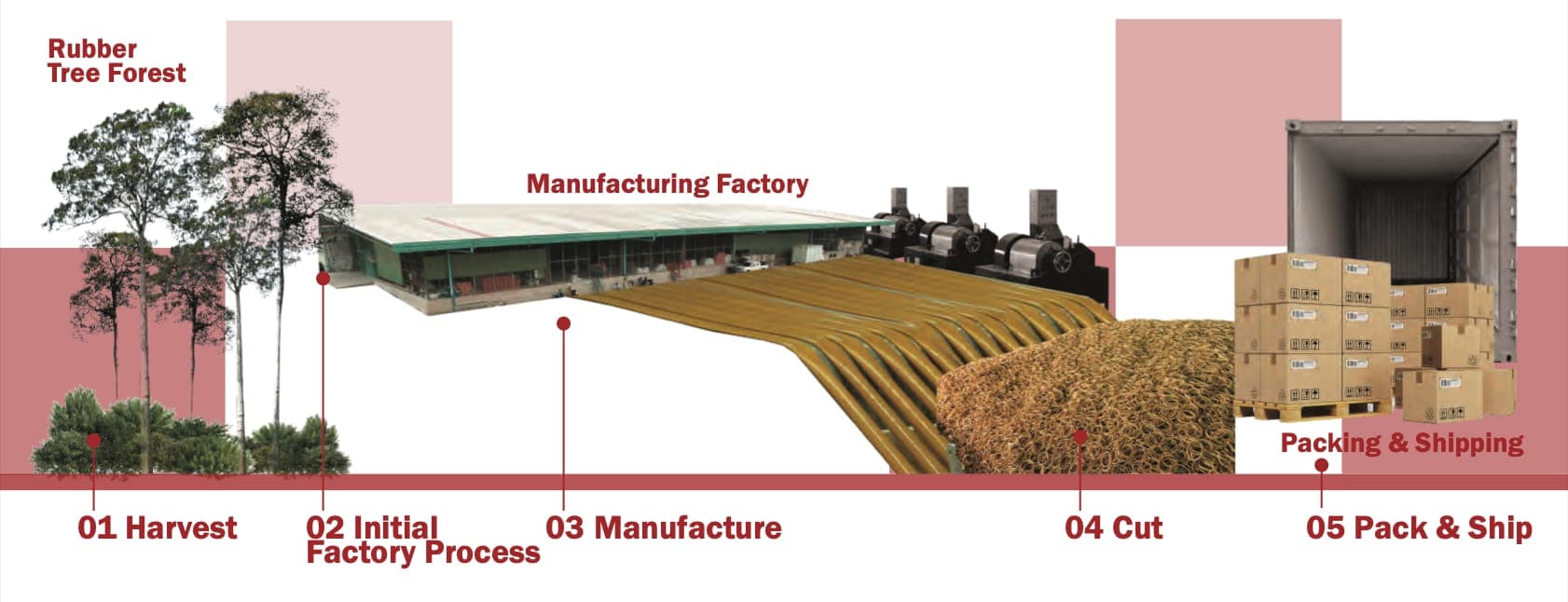
The 8-step manufacturing process below takes that raw latex from plantation to finished product.
Step 1 - Latex Harvesting
The process begins at dawn. Skilled plantation workers make a thin, diagonal cut in the bark of the rubber tree, allowing white, milky latex sap to flow into a collection cup attached to the trunk. Tapping happens in the early morning when cooler temperatures produce the highest latex flow.
Key facts about latex harvesting:
- Each tree yields approximately 50–100 ml of latex per tapping session
- Trees can be tapped every 2–3 days throughout most of the year
- The cut must reach the latex vessels beneath the bark without damaging the regenerating cambium layer - a skill that takes years to develop
Step 2 - Cup Lump Collection
Over several hours, the harvested latex coagulates inside the collection cup, forming a solid mass called a cup lump. Plantation workers collect these cup lumps every few days and transport them to a processing facility.
At Maruey Rubber, cup lump natural rubber band production is built on sourcing exclusively from trusted Thai plantations. Cup lumps are the primary raw material in rubber band manufacturing. They contain the natural rubber polymer alongside water, proteins, and organic compounds. The quality of the cup lumps directly determines the quality of the finished rubber band, which is why raw material standards are kept exceptionally high.
Step 3 - Compound Preparation
Raw rubber alone cannot produce a high-performance rubber band. The next step is compounding - blending the base rubber with precisely measured chemical additives to achieve specific physical properties.
Compounding takes place in large internal mixers (Banbury mixers) or open two-roll mills. Key additives include:
- Sulfur - essential for the vulcanization process
- Accelerators - control the speed and efficiency of curing
- Antioxidants and antiozonants - protect against aging and UV degradation
- Pigments - produce the final color of the band
The rubber and additives are blended under heat and mechanical shearing until completely homogeneous. The resulting master batch compound is then sheeted out and rested before the next stage. Getting this formula right is one of the most critical factors in determining the final band's elasticity, strength, and lifespan.
Step 4 - Extrusion
Extrusion is the step that gives a rubber band its tubular shape. The compounded rubber is fed into an extrusion machine, which forces the material through a precisely shaped die under high pressure. The die determines the tube's outer diameter and wall thickness - which directly control the finished band's diameter and width after cutting.
Different die sizes are used for different product types:
- Thin dies for fine natural rubber bands
- Large, thick dies for heavy-duty pallet bands and industrial packaging
Extrusion parameters - temperature, pressure, and feed rate - must be tightly controlled to ensure uniform wall thickness around the entire circumference. Any variation causes the finished band to stretch unevenly and fail prematurely.
Step 5 - Water Cooling
Immediately after extrusion, the hot rubber tube passes through a water cooling bath. This serves three purposes:
- Sets the tube's shape so it doesn't collapse or deform under its own weight
- Reduces temperature to a safe level for handling
- Prepares the tube for vulcanization
Cooling water temperature and bath length are calibrated carefully. Too fast, and internal stresses can develop that compromise final performance. Too slow, and the tube may sag or deform before reaching the curing stage.
Step 6 - Vulcanization (Baking)
Here, we have the vulcanization process of rubber bands explained: it is the most chemically significant step in rubber band manufacturing - and the one that creates the elastic performance buyers depend on.
During vulcanization, sulfur molecules form cross-links between the long polymer chains of natural rubber, creating a three-dimensional molecular network. This network is what gives rubber bands their characteristic snap-back elasticity: the ability to stretch and return to their original shape without permanent deformation.
The process:
- Extruded tubes are placed in large ovens or autoclaves
- Heated to 140–160°C for a precisely controlled duration
- Time and temperature are critical - under-cured rubber is too soft and loses its shape; over-cured rubber becomes brittle and snaps
A properly vulcanized rubber band can stretch to 6 or more times its resting length and return to its original dimensions without any lasting deformation. This is the fundamental property that makes a rubber band useful - and it is entirely a product of this step.
Step 7 - Precision Cutting
Once the vulcanized tubes have cooled to room temperature, high-speed precision cutting machines slice them into individual rubber bands at the specified width.
Cutting blades must be sharp and precisely aligned to produce clean, smooth edges without tearing or distorting the rubber. The cut width is one of three key specification parameters - diameter is determined at extrusion (die size), wall thickness at extrusion (die design), and width at the cutting stage.
Standard widths range from 1 mm (fine file bands) to 15 mm or more (heavy-duty packaging bands). A single one-meter tube cut into 3 mm bands yields over 300 individual rubber bands - multiplied across hundreds of meters of tubing produced per production hour, output volumes are substantial.
Step 8 - Weighing and Packaging
Rubber bands are sold by weight, not count, making accurate weighing essential. Digital scales measure precise quantities for each packaging format:
- 250g retail poly bags
- 1 kg office and reseller packs
- 25 kg bulk cartons
- 30 kg wholesale sacks
Packages are heat-sealed to protect bands from dust, moisture, and UV exposure during storage and transit. Retail packages include printed labels with barcodes and product information. OEM orders are packed in the client's own branded packaging.
Finished cartons are palletized, secured, and warehoused until loaded into shipping containers for delivery to customers worldwide.
Why Do Rubber Bands Snap Easily (And How to Prevent It)?
Many buyers ask: why do rubber bands snap easily (and how to prevent it)? The answer usually lies in manufacturing defects like uneven wall thickness during extrusion, or under-vulcanization during baking. To prevent snapping, choose natural rubber bands from manufacturers that maintain tight dimensional tolerances and perform batch-level tensile testing.
What Makes the Difference Between a Good and a Bad Rubber Band?
Every step in the process above has a direct impact on the quality of the finished product. Here is how manufacturing decisions translate into performance:
| Manufacturing Factor | What Goes Wrong When It's Poor |
|---|---|
| Raw rubber quality | Low elasticity, inconsistent stretch |
| Compounding formula | Premature aging, color fading, brittleness |
| Extrusion control | Uneven wall thickness, bands that snap on one side |
| Vulcanization timing | Bands too soft (no snap-back) or too brittle |
| Cutting blade sharpness | Rough edges that cause premature tearing |
This is why sourcing rubber bands from an experienced, quality-controlled manufacturer matters - not just for cost, but for reliability over the life of the product.
How Maruey Rubber Controls Quality at Every Step
Maruey Rubber has been manufacturing rubber bands at our Rayong, Thailand facility since 1992 - over three decades of continuous process refinement. Our approach to quality includes:
- 100% Thai natural rubber sourced from local plantations for superior raw material consistency
- In-process monitoring at every production stage - compounding, extrusion, vulcanization, and cutting
- Final batch testing for elongation at break, tensile strength, dimensional accuracy, and surface quality before any order ships
- Export-ready packaging tailored to each client's requirements, shipped from Laem Chabang Port to 60+ countries
Frequently Asked Questions
How long does it take to manufacture rubber bands?
A standard production run - from raw material preparation through compounding, extrusion, vulcanization, cutting, and packaging - typically takes several days. Full OEM orders, including quality testing and packaging, are generally ready for shipment in 30–45 days from order confirmation.
What is vulcanization and why does it matter?
Vulcanization is the chemical process that creates the elastic properties in rubber. Without it, rubber would be sticky, weak, and unable to return to its original shape after stretching. The time and temperature of vulcanization directly determine the performance of the finished band.
What is the difference between natural and synthetic rubber bands?
Natural rubber bands, made from Hevea brasiliensis latex, offer superior elasticity, tensile strength, and aging resistance compared to synthetic alternatives. Thai natural rubber is particularly prized for its high cis-1,4-polyisoprene content, which is the molecule responsible for elasticity.
Why does wall thickness matter?
Wall thickness determines both the strength of the band and how evenly it stretches. Inconsistent wall thickness - a result of poor extrusion control - causes the band to stretch unevenly and fail at the thinnest point.
Can rubber bands be manufactured in custom sizes?
Yes. Diameter, wall thickness, and cut width are all adjustable during manufacturing by changing the extrusion die and cutting parameters. Custom OEM rubber bands can be produced to virtually any specification.
Interested in Sourcing Rubber Bands from a Quality Manufacturer?
Whether you need standard sizes or fully custom OEM rubber bands, Maruey Rubber has the process expertise and quality systems to deliver a consistent product at scale.
Related Product
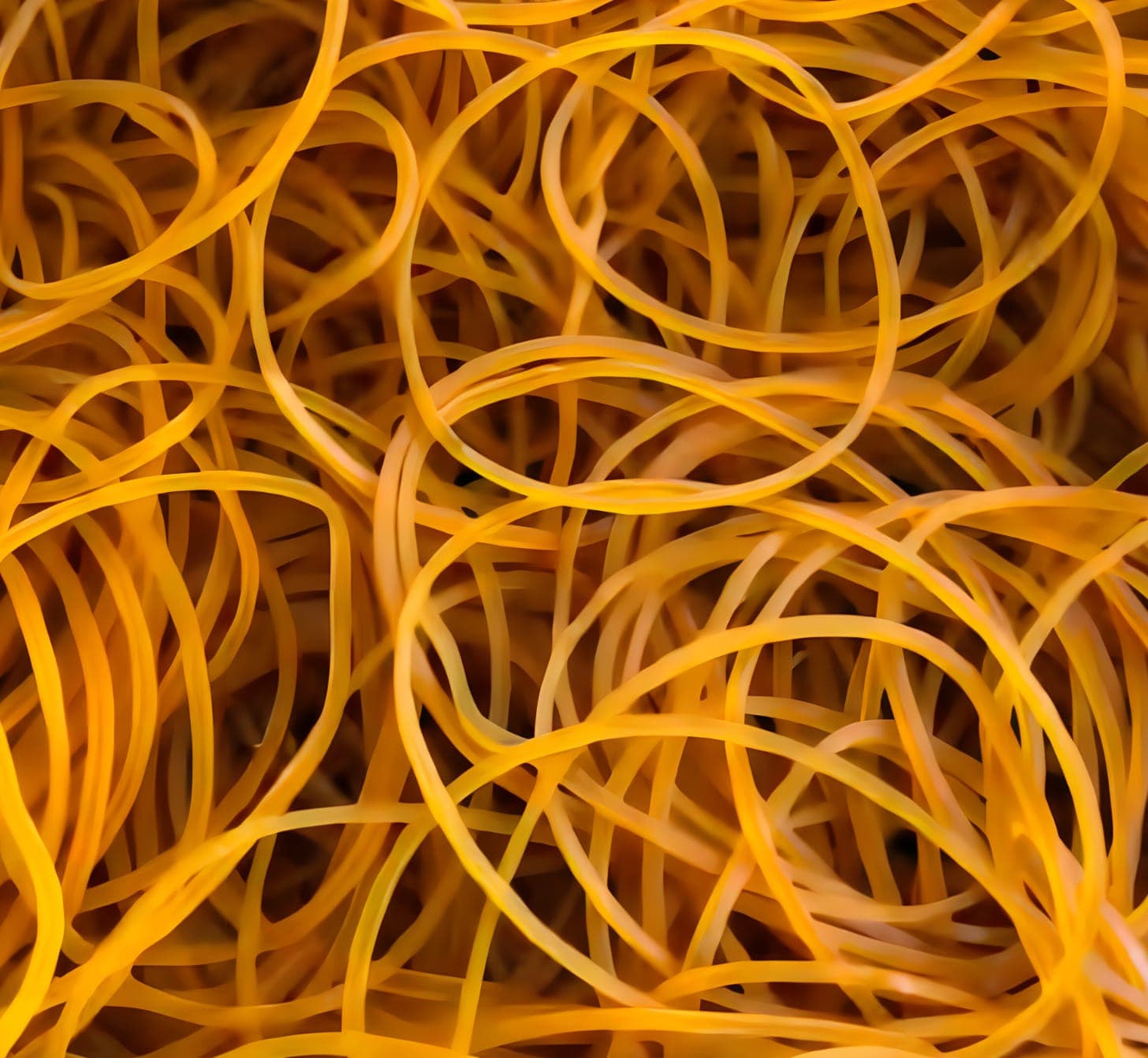
Rubber Band
The industry standard for versatile bundling and packaging
Our classic multi-purpose bands. Available in various sizes and colors. Perfect for general packaging, office use, and bundling small items.
See Product
Frequently Asked Questions
What is vulcanization and why does a rubber band need it?
Are rubber bands cut or molded?
Why are rubber bands sold by weight instead of by count?
Ready to Source Premium Rubber Bands?
Contact Maruey Rubber for pricing, samples, and custom OEM specifications. Over 30 years of manufacturing excellence from Thailand.