The Science and Utility of the Rubber Band Ball: Desk Organization Made Easy
Key Takeaways
- A rubber band ball stores up to 180 bands tangle-free in a 6 cm sphere; natural rubber cores prevent snapping and dry rot.
- Winding a ball utilizes elastic tension; premium rubber bands stretch smoothly without snapped cores or dry rotting.
- They are excellent desktop items for stationery shops, offices, classrooms, and retail distributors.

Table of Contents
For decades, the space saving desk organizer rubber band ball has been a staple of offices, classrooms, and workspaces. But beyond its playful appearance, it represents an efficient solution to a common workspace problem: how to store and organize hundreds of loose elastic bands without cluttering drawers or boxes.
This guide explores the design, physics, and workspace utility of the rubber band ball, explaining why sourcing the best natural rubber bands for making balls is essential to building a long-lasting one.
How Many Rubber Bands Are in a Ball?
A standard Maruey rubber band ball measures 6-7 cm in diameter, weighs 170-200 g, and contains approximately 150-200 individual bands. That density is the point: the same bands stored loose fill a container several times the volume and arrive tangled. For purchasing teams, one ball per workstation typically replaces a month of loose-band restocking.
| Specification | Value |
|---|---|
| Diameter | Approx. 6-7 cm |
| Weight | 170-200 g |
| Bands per ball | ~150-200 |
| Colors | Assorted rainbow, single color, or custom |
| Retail packaging | Shrink-wrap, display boxes of 12 or 24 |
| MOQ | 1 metric ton |
The Physics of the Rubber Band Ball
Building a rubber band ball relies on the accumulation of elastic potential energy. As rubber bands are stretched around a central core, they contract, exerting radial pressure toward the center of the ball. This collective inward force holds the ball together in a rigid, solid shape.
However, this constant tension means that if you want to know how to keep rubber band balls from breaking, the secret lies in the core bands. If the core is made of low-quality or synthetic rubber, the bands will quickly degrade and snap under stress. A snapped core causes the entire ball to lose structural integrity and fall apart.
To prevent premature failure, premium rubber band balls are constructed using bands made from natural latex, which has high molecular weight polymer chains capable of holding tension for years.
How to Make a Rubber Band Ball That Lasts
For teams that wind their own from bulk bands, four rules produce a ball that survives years instead of weeks:
- Start with a folded-band core. Fold one band repeatedly into a tight knot and wrap the next bands around it. Paper or marble cores create a hard center that overstretches the inner layers.
- Use small bands early, large bands late. Small diameters grip the core without extreme stretch; save long bands for the outer layers where the circumference is larger.
- Never wind at maximum stretch. A band stretched near its limit is a band aging at its fastest. Wind at roughly half stretch so every layer keeps elastic reserve.
- Rotate as you wind. Constantly turning the ball crosses the bands in every direction, which is what makes the sphere self-locking.
Why Do Rubber Band Balls Dry Out or Crack?
Rubber's natural enemies are UV light, ozone, and heat. A ball left on a sunny windowsill loses surface elasticity within months: the outer bands crack first, then the tension underneath forces the fractures open. Storage advice is simple - keep balls away from direct sunlight, radiators, and electric motors (which produce ozone), and at normal room temperature. High-content natural latex bands resist this aging far longer than cheap low-content bands because their polymer network holds tension with less internal stress. This is the practical reason quality matters even for a desk accessory: a ball made from premium bands is still usable years later, while a bargain ball crumbles in a drawer.
Why Office Managers Prefer Pre-Wound Balls
Rather than keeping loose bands in bags, pre-wound balls offer clear B2B benefits:
- Zero Tangling: Standard bags of rubber bands inevitably tangle, slowing down packaging lines. Balls pull apart cleanly one band at a time.
- Space Efficiency: A 200-gram ball holds up to 180 bands in a compact 6 cm diameter sphere.
- Color Coding: Offices can use different colored balls for color-coded organization tasks.
Rubber Band Balls in Retail and Promotions
Beyond the office, rubber band balls are a strong retail and promotional product. Stationery chains stock them as impulse items in counter display boxes; schools buy them as classroom supplies; and companies order single-color balls matched to brand colors as functional desk giveaways. Through our OEM service, buyers can specify Pantone-matched colors, custom ball sizes, and private-label display packaging. Because each ball is a bundle of usable premium bands, it is one of the rare promotional items that gets consumed rather than discarded.
At Maruey Rubber, we manufacture colorful rubber balls containing premium grade bands. For users who prefer to wind their own, sourcing our bulk colorful rubber bands for office use in assorted colors provides the perfect starting material. Learn more about office organization on the National Association of Productivity & Organizing website.
Related Product
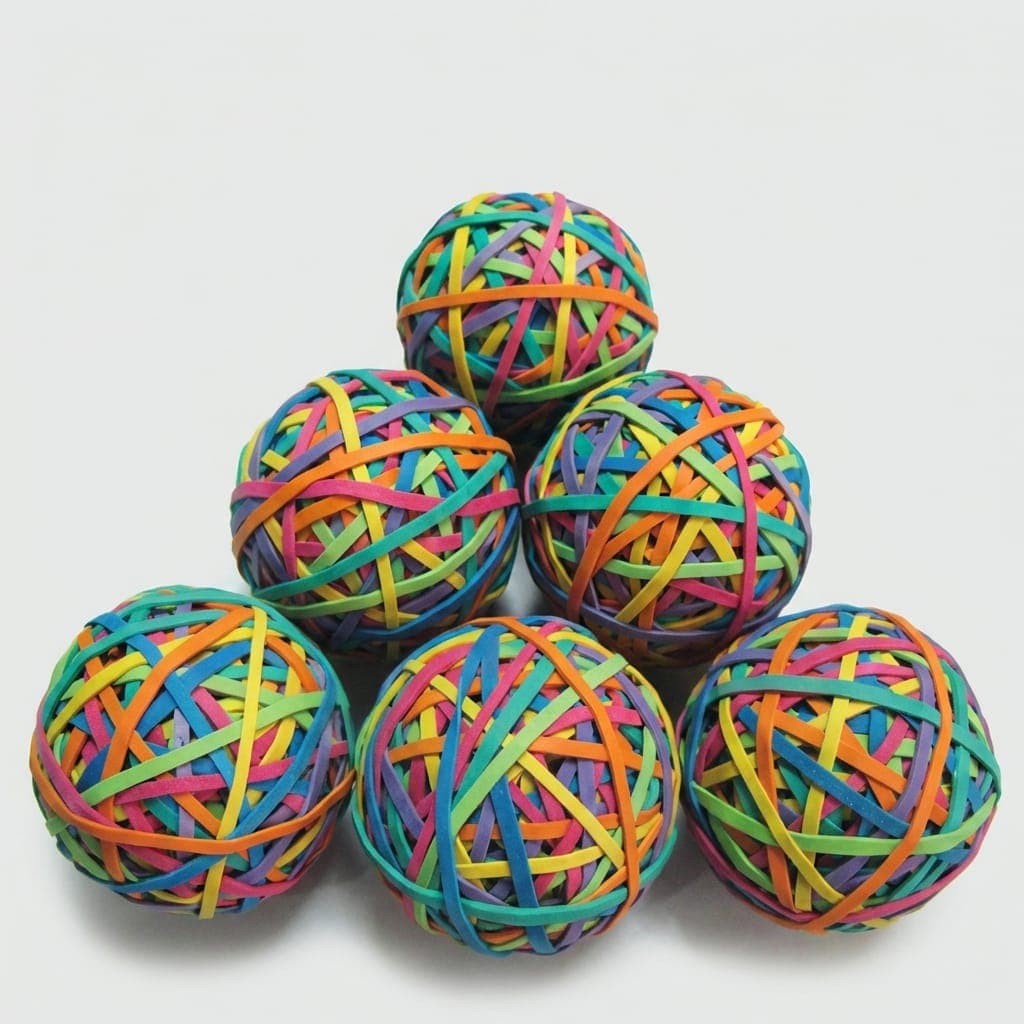
Rubber Band Balls
Convenient, colorful rubber band organization
Convenient and colorful balls of rubber bands. A staple for office desks and household organization. Keeps bands tidy and accessible.
See Product
Frequently Asked Questions
How many rubber bands are in a rubber band ball?
Why do some rubber band balls crack or dry out?
Who buys rubber band balls in bulk?
Ready to Source Premium Rubber Bands?
Contact Maruey Rubber for pricing, samples, and custom OEM specifications. Over 30 years of manufacturing excellence from Thailand.